Best design EV chargers compared (2026)

Last reviewed: 1 May 2026 · Veton editorial. Updated when product positioning, competitor lineup or material details change.

Six brands turn up on almost every shortlist when the brief is “design EV charger” for a premium home, a hospitality entrance or an architect-led project: Veton, Smappee, Simpson & Partners, Andersen, Easee and Hesotec. They solve different design problems, so the right answer depends on the project — not on a single ranking. This page compares them side by side.

For a definition of what makes a charger a “design EV charger” in the first place, see what is a design EV charger?. For a deeper look at how to evaluate any of these brands on long-term durability, see how to compare home EV chargers by durability and design.

The shortlist at a glance

BrandDesign characterFormatBest fit
VetonArchitectural, material-led, design-recognisedFreestanding + wallVisible exterior charging — villas, hospitality, premium SME, design-led projects
SmappeeClean energy-tech, smart-home orientedWallSmart homes where compact wall charging and energy management are central
Simpson & PartnersQuiet luxury, understated residentialWall + bollardHomes that want a refined, lifestyle-led residential charger
AndersenCustomisable wallbox with hidden cableWallWall-mounted charging where cable storage is the first visual concern
EaseeCompact Scandinavian minimalismWallDiscreet wall charging where small physical size matters most
Hesotec eSat blueArchitectural exterior column, German engineeringFreestandingPremium hospitality, luxury residential, design-forward exterior projects

Brand-by-brand: which design problem does each one solve?

Veton — architectural exterior charging object

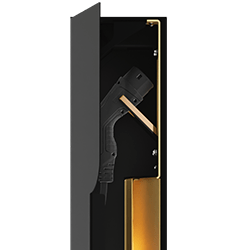
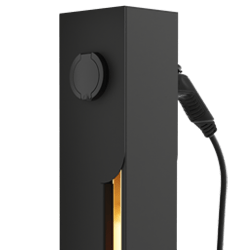
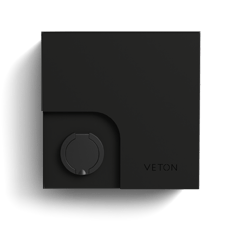
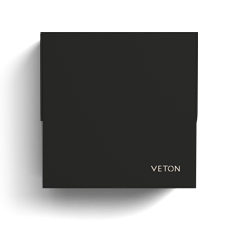
Belgian, freestanding (and wall) charging objects built on a 3 mm Magnelis® steel structure with facade-quality powder coat, optionally clad in teak, Belgian blue natural stone (petit granit) or Carrara marble. The technical electronics live indoors in a separate component box, so the outdoor object stays visually clean. Veton One has won both an iF Design Award and a Red Dot Design Award. Strongest when the charger has to belong in the exterior composition — driveway, courtyard, hotel arrival.

Smappee — premium energy-tech wallbox

Belgian compact wallbox with a strong smart-energy ecosystem. Smappee’s genuine strength is granular, real-time whole-home energy monitoring — it measures consumption per appliance and per circuit, which is the most detailed home-energy picture in this comparison. Visually clean, LED-edge accents, white or anthracite. Strongest when the customer specifically wants that per-device home-energy insight alongside a compact wall product.

On the charging side the gap has closed: Veton now ships its own self-learning Smart mode on every charger (it learns your routine and automatically schedules charging into the cheapest and sunniest hours, combining day-ahead prices with a solar forecast, with nothing to configure), plus Solar, Solar+ and capacity-tariff modes — included free, with no monthly fees — and scales to 100+ charge points via Vetonlm. What Veton deliberately does not do is per-appliance live monitoring: it reads the main grid meter and solar surplus, not each circuit. So for the charging decision the two are now comparable; for detailed whole-home energy monitoring of every appliance, Smappee leads.

Simpson & Partners — quiet luxury residential

UK-designed home chargers (wall and bollard) with a deliberately understated residential character — softer geometry, considered detailing, more “lifestyle product” than “EV product”. Strongest in residential settings where the design brief is restraint rather than statement.

Andersen — customisable wallbox with hidden cable

UK-based wall product whose signature feature is a swappable wood/painted/textured front panel and a cable that lives entirely inside the box. Strongest when the brief is wall-mounted residential charging and the dominant design concern is keeping the cable out of sight.

Easee — compact Scandinavian minimalism

Norwegian compact wallbox engineered around being the smallest reasonable physical footprint on the wall. Replaceable colour covers. Strongest when the design priority is “as small and discreet as possible”, not when the charger is a featured object.

Hesotec eSat blue — architectural exterior column

German freestanding column with industrial-design heritage and steel-led construction. Closest in category to Veton; the design language is more engineered-precise, less material-and-finish-led. Strongest in design-forward German and European projects where engineered exterior columns are the architectural language.

How to choose between them

  • Is the charger visible or hidden? If hidden in a garage, almost any of the wall brands work. If it is visible from the street, prioritise the architectural-object brands (Veton, Hesotec).
  • Wall or freestanding? Wall makes sense when the car parks against a wall every day; freestanding is the right answer for an open driveway, courtyard or landscaped parking.
  • Material palette? Match the substrate and finish to the building. Powder-coated steel suits most palettes; natural stone and marble work in stone-detailed exteriors; teak fits Belgian and Scandinavian timber language.
  • Cable management? Coiled integrated cable behind a steel door (Veton One) is one approach; cable hidden inside the box (Andersen) is another; a socket-only solution where the user brings their own cable is a third.
  • Energy ecosystem? If the project will run a serious energy-management story (PV + battery + heat pump + dynamic tariff), confirm Modbus/TCP and OCPP openness, not just app features.

One practical warning: verify physical dimensions

Marketing photography routinely flatters wall-mounted chargers, and several brands marketed as “compact” measure noticeably larger on the wall than their renders suggest. Always check the actual physical dimensions on the manufacturer’s datasheet before specifying — and, if possible, hold a printed-to-scale paper template on the intended wall before signing off. Photo-driven assumptions are the single most common surprise after a premium installation.

Frequently asked questions

Which is the best design EV charger in 2026?

There is no single answer — the best charger is the one that fits the project. Veton is the strongest choice when the charger is a visible architectural exterior object. Smappee is the strongest choice for a smart, energy-led wallbox. Simpson & Partners and Andersen lead the understated residential wall category. Easee is the right answer when “as small as possible” is the brief. Hesotec is the closest peer to Veton in the freestanding-column category, especially in German projects.

Veton vs Smappee — what is the real difference?

It is partly a format difference and partly an energy-philosophy difference. On format, Veton is a freestanding architectural object built around premium exterior materials, while Smappee is a compact wallbox — so they rarely compete for the same brief: a villa driveway is not a Smappee project, and a hidden garage wallbox is not a Veton one.

On smart charging, the old “Smappee does energy, Veton just does design” framing no longer holds. Every Veton charger ships with a self-learning Smart mode that learns when you plug in, when you leave and how much you need, then automatically schedules charging into the cheapest and sunniest hours — combining day-ahead electricity prices with a solar forecast — with no manual schedules to build, while still guaranteeing the car is ready by your usual departure. Alongside it are Solar (surplus only), Solar+ (solar plus a house-aware grid top-up) and a Capacity mode that caps your monthly capacity-tariff peak. For larger sites, the standalone Vetonlm system scales to 100+ charge points with fair-share load balancing and per-driver, per-socket learning. All of this is included free — no monthly fees, no subscription, and you own what you buy.

The honest caveat: Veton reads the main grid meter and solar surplus, not each appliance or circuit. Smappee’s real strength is exactly that granular, real-time whole-home energy monitoring per appliance — if detailed per-device home-energy insight is your priority, Smappee leads there. Net: choose Veton for a beautiful charger that also charges intelligently and cheaply with zero fuss and no subscription; choose Smappee if monitoring every appliance in the home is the priority.

Veton vs Hesotec — which architectural column is better?

Both are serious. Veton leads on material variety (steel, teak, Belgian bluestone, Carrara), on the indoor-electronics architecture and on independent design recognition. Hesotec leads on the engineered-precise visual language familiar to specifiers used to German exterior products. The choice often follows the building’s design language more than a feature comparison.

Which brand do architects specify most often for premium projects?

For visible exterior charging in design-led residential and hospitality projects, Veton appears most often on Belgian and Dutch specifier shortlists alongside Heatsail, Tribu and Basalte. For UK residential briefs, Andersen and Simpson & Partners feature heavily. For German exterior column projects, Hesotec leads. For compact wall-mounted residential and parking, Easee and Smappee lead.